Decentralized phygital identifier systems for digital passports in circular construction: a design science evaluation
Sep 1, 2025·, ,,,,·
0 min read
,,,,·
0 min read
Brandon Byers
Pascal Emmenegger
Jens Hunhevicz
Daria Schumm
Felix Heisel
Daniel Hall
Catherine De Wolf
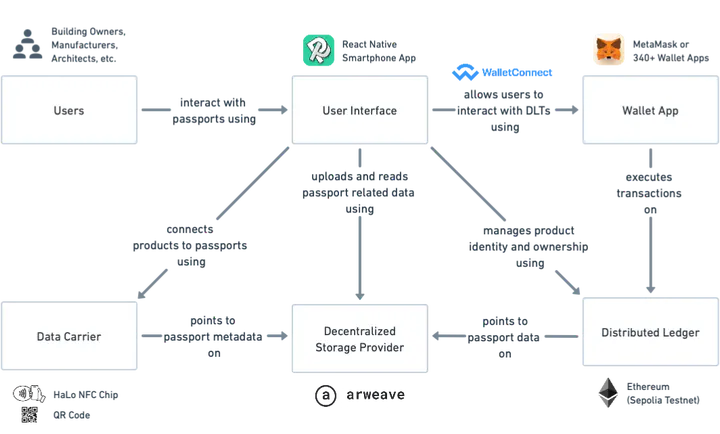 System architecture for creating a passport.
Abstract
Purpose - Circular construction promotes the reuse of building components, yet a key challenge is to reliably link long-term information with physical products. This study aims to investigate how to implement a decentralized identifier system linking physical products to their digital data, and the design requirements necessary to evaluate these systems within circular construction. Design/methodology/approach - A pragmatist sequential multi-methods approach is applied, integrating technical prototyping, performance evaluation, and stakeholder validation. This study explores different identifiers (decentralized identifiers (DIDs) and tokens) and data carriers (QR codes and NFC chips). A mobile application prototype is developed and tested for operational efficiency, cost-effectiveness, and usability. Findings - QR codes outperform NFC chips in ease of use and efficiency, while DIDs offer higher interoperability compared to token-based identifiers. Blockchain technologies ensure long-term data integrity but introduce cost and complexity trade-offs. Stakeholder feedback highlights the importance of accessibility, user interface clarity, and legacy system interoperability for successful adoption. Research limitations/implications - This study is exploratory, with validation conducted in controlled environments rather than active deconstruction sites. Future work should test long-term performance in real-world reuse scenarios. Nonetheless, the findings have broad implications for research, practice, and society by guiding the development of robust traceability systems that enhance building component reuse and tracking for construction practices Originality/value - This research contributes to circular construction by systematically evaluating decentralized and physically backed identifiers for tracking building components. It provides empirical insights into various technological configurations and establishes a foundational design framework for digital product passports in circular supply chains.
Type
Publication
Construction Innovation