A modular building-block framework for navigating circular carbon pathways

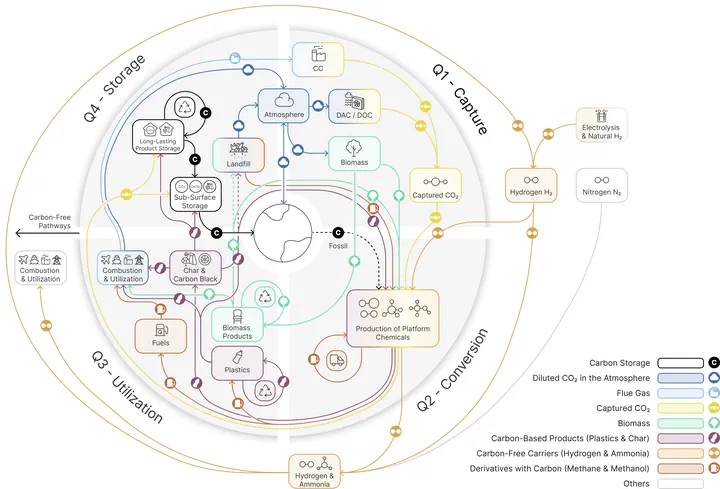 Conceptual layer of the modular building block framework for the anthropogenic carbon cycle. The cycle is organized into four functional quadrants: Q1 – capture, Q2 – conversion, Q3 – utilization, and Q4 – storage. Carbon-bearing and carbon-free streams are categorized into eight types (color-coded; see legend). The gray inner circle represents carbon-based pathways, while carbon-free pathways such as hydrogen and ammonia are shown outside the circle.
Abstract
Effective decarbonization and carbon removal require tools that facilitate holistic yet detailed decision-making across interconnected carbon pathways; however, existing research often isolates technologies and focuses on linear process chains. To bridge this gap, we present a modular framework for carbon pathways based on process interfaces. Through an adapted iterative taxonomy-development method, we decompose and abstract the anthropogenic carbon cycle into 40 technological building blocks defined by their input and output streams. From this component library, pathway configurations can be assembled and classified by carbon source and fate (Carbon Capture and Storage, CCS; Carbon Capture and Utilization, CCU; Carbon Capture Utilization and Storage, CCUS) and categorized by their resulting carbon balances (net-negative, net-zero, net-positive). The resulting three-level abstraction model links policy-relevant carbon balances to pathway configurations and specific technologies, enabling flexible navigation between emerging technologies and established circular value chains and revealing synergies and trade-offs. The framework equips decision-makers with a practical tool to design and assess systemic circular carbon strategies.
Type
Publication
RSC Sustainability